Stuck in Khe Sanh
For newer subscribers, I'm re-posting this short story (slightly updated) about an old Vet who gets stuck in Khe Sanh all over again.

“I survived, but it’s not a happy ending.”
Tim O’Brien
ON A FINE SPRING DAY, a cavalcade of motorbike enthusiasts has been riding on various steeds – Yamahas, Kawasakis, and a few sputtering two-stroke relics – through the Central Highlands of Vietnam to the town of Khe Sanh in Quảng Trị province, where these Easy Riders will stay the night.
Since departing the city of Huế after a hearty breakfast – eggs and banh mi for the westerners, pho for the Vietnamese – the weather has been idyllic: just the right amount of cloud coverage and, every so often, a welcome breeze blowing inland from the East Sea. It’s a ‘pleasure ride’ so they roll along the road, taking their time to drink it all in – the vastness, the stillness, the lushness; the beauty of Vietnam, once again, moving each of them to their core, reaffirming their belief that they are both lucky and destined to be there. And although they never venture off-road to ride down muddier tracks, when they rumble into Khe Sanh at sundown, they’re dusty, they’re hungry, and they’re thirsty. As is customary on such trips, they all disperse to their rooms to scrub up and then reassemble downstairs in search of food and beer.
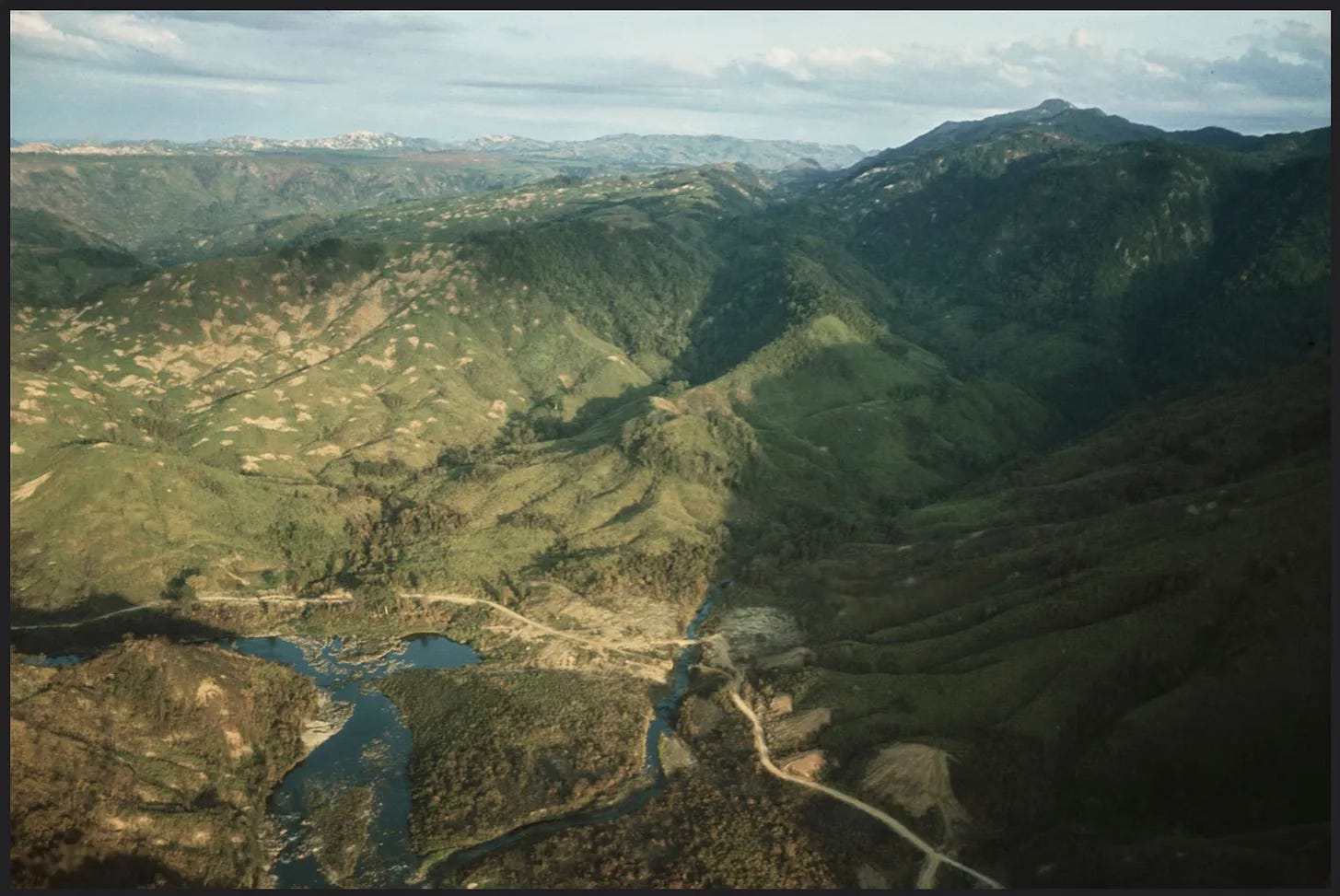
Every member of this motorised entourage – a mix of Vietnamese and foreigners who are either long-term residents or frequent visitors of Vietnam – knows something of Khe Sanh’s historic significance. Most of the Vietnamese motorcyclists are the children of a generation that fought in what they call ‘the American war’ – their knowledge isn’t academic, it’s inherited. And many of the foreigners on this ride have done a lot more than just watch Platoon (and Hamburger Hill). Some have studied, if only informally, what played out in this mist-shrouded valley near the Laotian border in 1968. They’d know that in late 1967, the US President Lyndon B. Johnson looked at a map of Central Vietnam in the White House’s ‘Situation Room’ and barked at his Joint Chiefs of Staff: “I don’t want any damn Điện Biên Phủ!”1 But Johnson was assured that the military base in Khe Sanh – considered vital to halting the southward push of North Vietnamese troops – would not be overrun. And it wasn’t. The Vietnamese eventually pulled back after a 76-day long siege that resulted in 205 dead on the American side and on the Vietnamese side, well, no one seems to agree. Some say just over 1,600 died. Others suggest a figure closer to 20,000. And after all those deaths? The Americans changed their mind about the importance of Khe Sanh, blew up their own bunkers, rolled up their temporary airstrip and, on July 5, 1968, they left.
Today, the site is home to a war memorial and museum, one which honours the Vietnamese forces that attacked the base. But this posse of Easy Riders has not come to town to pose for pictures, as many do, while standing beside the American machinery that got left behind – say, a Howitzer, or a Chinook chopper. They’re just passing through. When they convene in the hotel restaurant for dinner (a spread of fortifying Vietnamese staples – spring rolls, caramelised eggplant, grilled lemongrass chicken, pork ribs in a sour soup, water spinach, a mound of rice), they do not speak of Khe Sanh’s history. Instead, they share impressions of the day, praising the beauty of the mountains that stand where they have always stood, and then they trade stories of previous rides and their most embarrassing crashes. Three have swerved off the road to avoid livestock and crashed. In every instance, locals appeared to help them get their vehicle back onto the road. One Easy Rider was even treated to lunch by a farmer’s family after crashing headlong into a paddy field – despite the disruption he’d caused, or perhaps because of it.
As the evening wears on, the beers flow freely and every eruption of laughter is louder than the last. They’re having such fun that no one acknowledges the lone guest on the other side of the dining room: an old white guy in a check shirt, slacks, and baseball cap, with only a 750ml bottle of Johnnie Walker for company. But eventually, one member of the group, a French-Vietnamese photographer known for his sympathetic eye, leans into the group and asks, “Hey, should we ask that guy to join us?”
Before anyone makes a move to extend an invitation, one of the old hands at the table – a public health worker from Adelaide whose father did a tour at Núi Đất with the Anzacs in the dry season of ’67 – says, “I’d bet anything that’s an ex-US Marine who was stationed in Khe Sanh.”
When the lone guest joins the party, he confirms it: “Yes, sir. Echo Company, First Battalion. Khe Sanh, ‘68,” he says, as if hardwired to do so. “Proud to say we held the hill…”
Held the hill? One of the Easy Riders, a Kiwi lawyer who rarely pulls punches – professionally, or socially – chooses to bite his tongue. Well, yes, he thinks, with the help of over 100,000 tonnes of bombs, you held the hill. Indeed, everyone at the table knows the story. Infuriated by the North Vietnamese guerrilla tactics, the US military spent billions trying to obliterate what cloaked its enemy. In early ’68, B-52 Arc Light strikes reduced entire hillsides and forests to cratered wastelands. Even today, Quảng Trị Province remains one of the most UXO-contaminated regions in Vietnam. And then there were the chemicals – Agent Orange, Agent White, and other defoliants – sprayed in obscene quantities, poisoning the soil and destroying entire ecosystems. But even if most of the Easy Riders know all of this, they instinctively hold fire. They recognise that the Vet is just an old man who needs a place to sit – and perhaps giving him a little recognition won’t hurt. So they each raise a glass to welcome another fellow traveler to the table, and the evening continues.
When the conversation splinters across the table, those near the Vet do their best to chat casually with him but someone touches a nerve by asking if he’s visited the old combat base. “When hell freezes over,” he snaps back before admitting he’s been sitting in the hotel for days without venturing outside. Still, it seems he wants to talk about the siege, as if that’s why they’ve all been summoned to this musty dining room. No one asks what it was like inside the base but he tells them anyway. “The Viet Cong had the hill zeroed in. Every hour brought more artillery. I was so scared I couldn’t eat, I couldn’t sleep, hell, I couldn’t shit.”
Though some of the Easy Riders are curious to hear more of the Vet’s story, the whisky soon takes its toll on him. He begins to ramble incoherently, almost as if he’s looped back in time and the siege is still going. He has no interest in who the Easy Riders are, where they’re from, or what they think. He assumes they’re allies. As for the Vietnamese? He called them “gooks” then, and he calls them “gooks” now – unaware, or perhaps incapable of registering, that a bunch of people at the table are Vietnamese.
But even if someone told the Vet where they were from, he wouldn’t be able to compute it – how could he be sitting with some Vietnamese, when they’re still out there in the jungle? To him, any friendly Asian must be a pro-American Filipino. And yet, the Vietnamese listening to this Vet are not angered by anything he says. They see him for what he is – a confused, traumatised man whose youth was wiped out by a senseless war and is now slurring his way to the end of a bottle of whisky.
After draining one more glass, the Vet falls silent and his eyes lose focus, as if he’s hearing it all again – the thwack of a Huey flying overhead as he crawls through the mud; the screams of the wounded, his heart beating against his chest like it’s about to burst. Then, without a word, he stumbles to his feet and staggers out of the dining room.
Two of the Vietnamese Easy Riders – both born in the summer of 1975, when Vietnam was finally at peace after decades of war – follow the Vet, instinctively knowing he won’t make it on his own. Sure enough, they find him in a heap in the hallway, too drunk to crawl to his room. They lift him to his feet, ferry him down the corridor, and after helping him dig out his room key, they ease him onto the bed, where the near-comatose Vet mumbles his thanks to his “Filipino buddies” and even tries to tip them. Before exiting the room, the two Vietnamese men place the Vet’s crumpled bucks on the bedside table and then, as he’s already snoring, they quietly turn off the light.
BY THE TIME THE VET wakes in the morning, the Easy Riders have already risen, eaten breakfast and checked out. The sun is already rising into a clear blue sky, and a long journey back to the coast is ahead. Back in their saddles, the Easy Riders break up as a pack and cruise at their own pace, riding past coffee farms, fields of cassava, rubber and banana plants. Along their merry way, they follow gentle curving roads and trade hullos with every boy and girl they pass. And when they ease off the throttle, they hear birdsong, the chirping of crickets, the distant greetings of farm dogs; and they each ride away from Khe Sanh with a wide grin on their face.
Only later, over a simple picnic of quail eggs and banh mi, do they speak of the Vet – not with resentment but sympathy and compassion. For the Vietnamese Easy Riders especially, forgiveness isn’t even the point – they never accused him of anything, not even of serving in an army sent halfway around the world on a mission to decimate their people and their land. In their minds, they who are at peace with themselves, each have a sincere hope that the Vet will find a way, someday, to reconcile the past. But will he? Could he? Well, let’s say he at least plucks up the courage to visit the old combat base, where he will wander around and stare at the rusty military vehicles, now oddly stationary in his eyes. And standing there, wiping the sweat from his brow, he will realise that all he has to do is thank his God, or whatever the hell he believes in, that he survived that shitty war, and that he doesn’t even need to be here. He is free to walk away, free to leave, free to go home. Whatever happened then can be buried or treasured. It doesn’t matter anymore. And after this brief epiphany, he will shuffle toward the exit, pausing only to catch his breath in the shade, where he will hear his damaged lungs audibly hissing, unseen insects in the weeds chirring, and two giddy boys shrieking as they sprint along the old runway. And then he will note a curious sight: three young girls, all under the age of 10, dressed in pink and rose-red outfits and wearing oversized sun hats – unexpected blossoms in this once-forsaken land. Their parents must be somewhere else, posing for selfies in front of some rusted tank or weathered helicopter, but these girls have no interest in the vestiges of an ancient war. Instead, they sit in a close-knit huddle, giggling as they play ‘rock, paper, scissors’, saying over and over:
“Oẳn tù tì, ra cái gì, ra cái này!” [Wan-too-tee – What will come out, comes out now!]
Enjoy this story? You can support Connla’s research and writing by making a small payment via Ko-Fi or directly via Paypal below.
For those that don’t know, a reference to the valley where the Vietnamese had outthought and outfought a foreign army in 1954. That victory for the Viet Minh proved decisive, essentially marking the end of French colonial rule in Indochina. Although President LB Johnson didn’t “want another damn Điện Biên Phủ’, I have read that General William Westmoreland was happy to reenact it only with all of the American machinery and weaponry at his disposal. Choppers, planes, tanks, heavy artillery, advanced communications systems, and an endless flow of ammunition and supplies – and on and on.